

関連記事
超高速電気泳動バッファー:明瞭さを失わずに高速なDNAゲルを
2026-09-16Although agarose gel electrophoresis is simple and reliable, the time for conventional electrophoresis is sometimes a limiting factor in a busy molecular biology laboratory. If a laboratory runs a number of PCR reactions, restriction digests or cloning samples per day, a 30-minute run can become a significant bottleneck when multiple gels are processed each day.
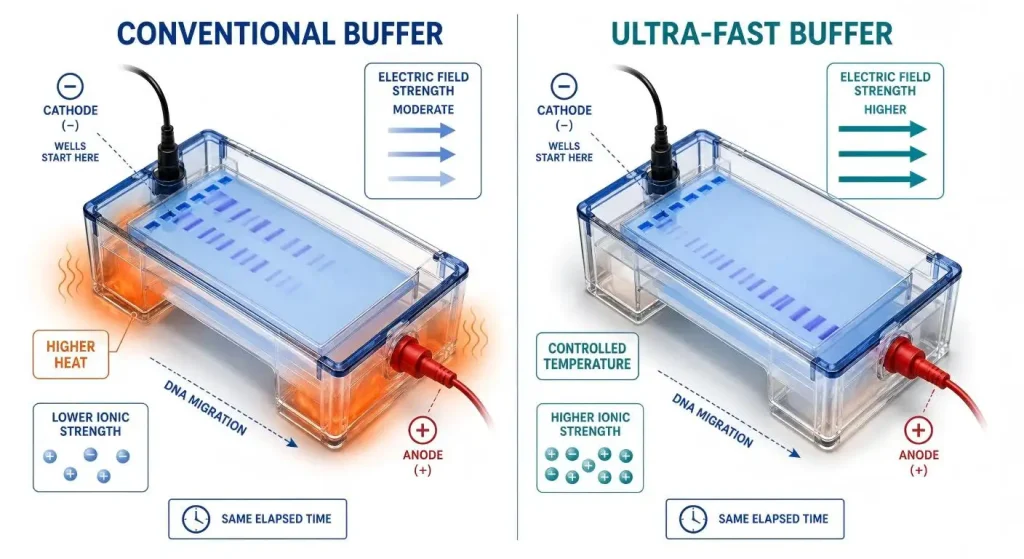
An ultra-fast electrophoresis buffer is formulated with lower ionic strength, which reduces conductivity and current at a given electric-field strength and therefore limits Joule heating. This allows higher field strengths to be used under validated conditions, shortening separation time while maintaining useful band resolution.
Ultra Fast Electrophoresis Buffer—What is it?
An ultra fast electrophoresis buffer is a low-ionic-strength electrophoresis buffer that has been optimized for rapid separation of DNA fragments in agarose gels. Supplies the ions necessary for electrical conductivity and for chemical conditions during migration.
The ionic strength of this buffer is lower than that of most traditional buffers, so less heat is created at a given operating condition due to the current. This can allow the use of a higher voltage gradient in the laboratory and shorten the run time.
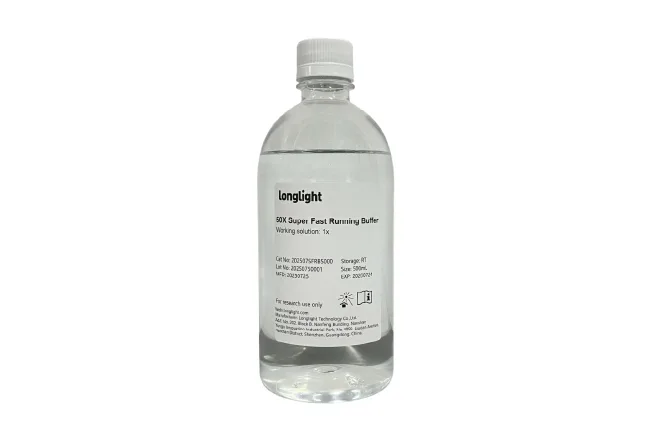
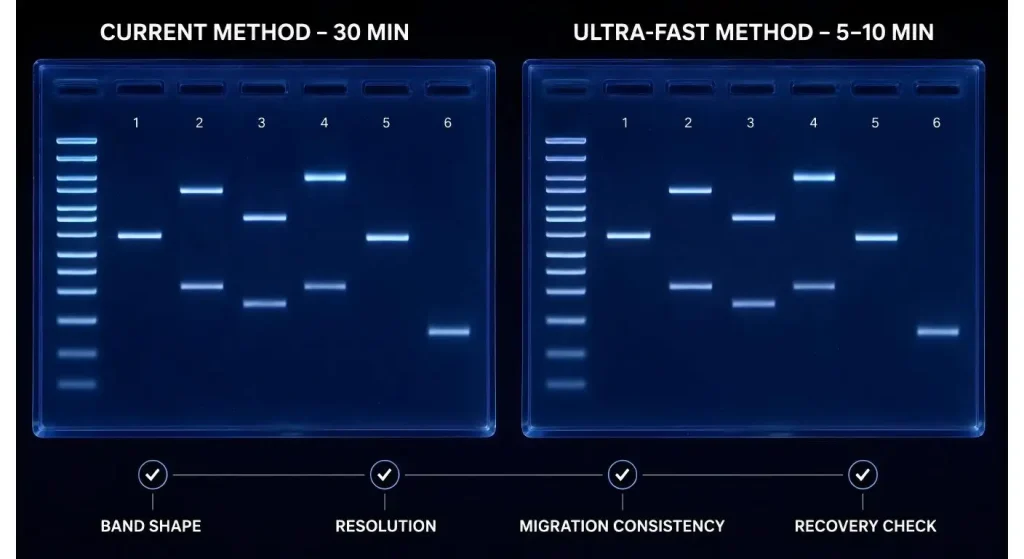
Longlight's 50倍の超高速実行バッファ is provided as a concentrated solution, and will shorten the time of separation from the typical 30 minutes to about 5-10 minutes based on the recommended conditions.
The reason why lower ionic strength can enhance running speed?
DNA has a negative charge and migrates towards the positive electrode in an electric field. The higher the electric field, the faster the DNA travels, though, conventional buffers can produce significant heat at high electric field.
Overheating can cause the agarose to melt, leading to bent lanes, curved bands or damage to the electrophoresis equipment. Low ionic strength buffer results in less current; less heat is generated, making it more feasible to operate at higher voltage.
This isn't to say that voltage can be raised indefinitely. The dimensions of the gel, the buffer depth, the design of the chamber, and the ambient temperature and power-supply capacity continue to affect the run.
Will Faster Electrophoresis result in Less Resolution?
When the buffer, concentration of agarose, voltage and the distance of the run are appropriate to the sample, good separation can be achieved with a fast run. The conditions are typically not checked when a method is transferred, which results in poor resolution.
For fragments to separate they must have sufficient migration distance if they are close in size. If the run is stopped too soon they may be compressed, even if the tracking dye is seen to have moved, near the wells.
It is important for laboratories to recognize the difference between an analysis to determine presence or absence and a high resolution analytical gel. The first may have to have a shorter gel time, and the second may need a longer gel time or slightly lower voltage.
How to Prepare a 1X Working Buffer from a 50X Concentrate?
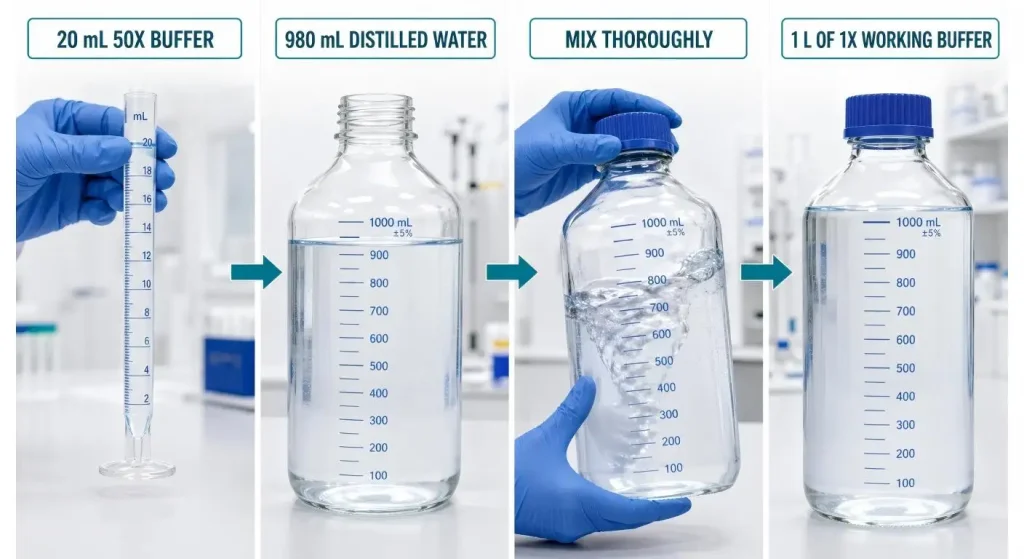
50 X concentrate should be diluted to a 1 X working solution. For instance, to make 1 L of 1X working buffer, mix 20mL of 50X concentrate with 980ml of distilled or demineralised water.
Shake well prior to casting or filling the chamber. For both agarose gel preparation and running tank, use the same 1X preparation to maintain consistency in conductivity of the system.
Don't dilute the buffer below the recommended working concentration for the purpose of further reducing current. Weak buffering and/or inconsistent band patterns can result from incorrect concentration which can lead to abnormal migration.
何が Correct Voltage to Set?
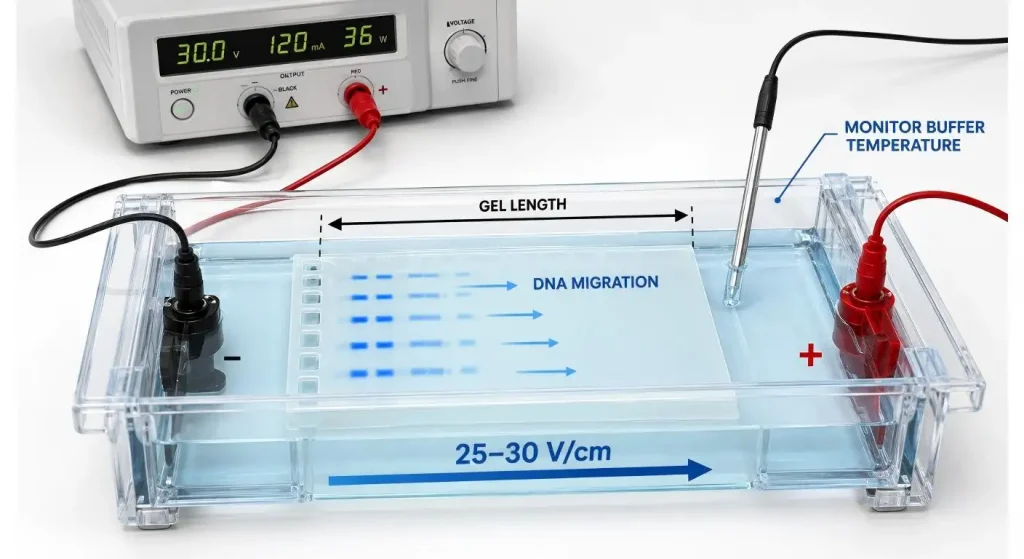
The voltage should be determined by the effective gel length, and not just selected from a familiar set-up on a power supply. Longlight recommends the use of about 25–30 V/cm of gel length with its fast-running buffer.
But the final setting should also take into consideration the electrophoresis chamber and the type of gel and buffer temperature. The final voltage should also account for gel length, sample load, chamber design and buffer temperature.
The power supply needs to be stable in output at the desired setting. The EP-600 electrophoresis power supply made by Longlight is designed to provide stable electrophoresis power supply for the laboratory.
What Gel Conditions Have Not Changed?
Buffer cannot overcome the use of an agarose concentration that is not suitable. The lower concentration of agarose will tend to support the higher molecular weight fragments, and the higher the agarose concentration the better the separation of smaller fragments of DNA.
The thickness of the gel is also important. Thick gels may take longer to stain and may have more heat. Clean formation of wells and loading samples without damaging the edges.
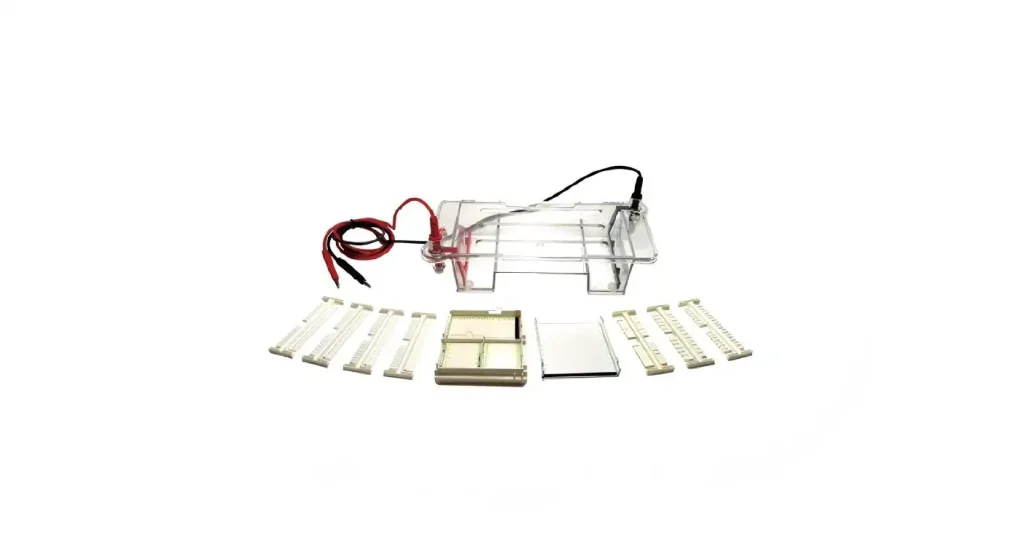
A compatible horizontal chamber allows to equalise the electrical conditions. The HE-50 横型ゲルシステム is compatible with multiple gel systems and features a low buffer consumption chamber design.
What Stain and Visualization Methods to Use for DNA?
Depending on the product and protocol, a nucleic-acid stain can be incorporated during the preparation of the gel or can be applied after electrophoresis. When comparing a fast buffer to an existing staining method, the staining method must be the same.
Very short runs may affect the perception of staining intensity, especially if bands run a short distance. It is important to adjust the exposure, thus, as a consequence of the above, not to copy automatic exposure from a conventional run.
LongLight's RedView核酸染色 can be used to visualize DNA and RNA in agarose and polyacrylamide gels and works with common imaging equipment.
Is it possible to retrieve DNA following a quick run?
Yes, as long as the buffer and stain have no effect on gel extraction and on downstream reactions. According to Longlight, 50X Super Fast Running Buffer does not affect DNA gel extraction or ligation.
Minimize unnecessary exposures to UV light and remove as small a gel slice as feasible for best recovery. The band should be kept separate so as to be distinct enough that no neighbouring product is included.
When validation of a method is for cloning or sequencing or other sensitive downstream process, assess yield, purity, and performance of recovered DNA.
When to Change Running Buffer?
Some buffers can be reused but reuse should be controlled and not solely on the basis of the appearance. With repeated runs, temperature, ion distribution and buffer performance may be altered.
If migration is slowed down, the bands are not of the expected shape or the solution becomes contaminated, replace the buffer. Another reason for this to be a good time for checking the buffer is that the room temperature is high, and after back-to-back faster runs.
If the sample is important or has a low input, it is recommended that fresh working buffer be used to avoid unnecessary variation.
What are the proper steps for the Laboratory to validate the Switch?
Use a known DNA ladder and samples. Use the same gel concentration, sample volume and staining method on the existing buffer and the ultra-fast buffer and run them in parallel.
| Validation Item | Existing Method | Fast-Buffer Method |
| Gel format | Record dimensions | Keep identical initially |
| Agarose concentration | Record percentage | Keep identical initially |
| Voltage gradient | Record V/cm | Test recommended range |
| Separation time | Record minutes | Record actual endpoint |
| Band quality | Shape and resolution | Compare with control |
| DNA回収 | Yield and purity | Verify downstream suitability |
Match run time, band shape, separation of close fragments and migration consistency and image quality. When gel extraction is involved in the workflow, evaluate the yield of the gel extraction and one downstream reaction as well.
Once accepted document the dilution, the voltage gradient, the size of the gel, the length of the run and how the gel was stained and how many times the buffer was used. Longlight's general reagents and consumables are designed to facilitate regular genomics and molecular biology applications.
結論
Ultra fast electrophoresis buffer can transform agarose gel analysis into a speedy quality check. The advantage is that it allows a lower ionic strength and yet a higher usable electric-field strength.
However, all aspects of 1X preparation, gel and running buffer matching, agarose concentration and temperature control are still crucial to ensure reliable results. A short side-by-side validation allows laboratories to shorten run time without sacrificing interpretable band separation.
FAQ
Q1. Can ultra fast electrophoresis buffer be used with a DNA gel?
Yes. Designed for fast separation of DNA in agarose gel. Users are advised to verify the compatibility of the gel chamber, staining and downstream workflow.
Q2. Is 50X buffer ready to use?
No. A 50X concentrate must be diluted to 1X before gel preparation or electrophoresis. Using the concentrate directly would result in excessively high ionic strength and conductivity, leading to excessive current and heat generation during electrophoresis.
Q3. Are the same buffer used for casting and for running the gel?
Yes, the same batch of 1X working buffer is recommended for both. This helps to maintain buffer strength throughout the gel system.
Q4. Does the gel heat up if the voltage is increased?
It can if not buffering adequately, voltage or chamber conditions are not suitable. For multiple runs and/or warm laboratories, monitor buffer temperature.
Q5. Is it possible to recover DNA from a fast electrophoretic separation for ligation?
Yes, if an appropriate stain and buffer are used. Laboratory's initial validation should encompass recovery and ligation performance.
